
Readiness Is Not a Switch: What Trauma-Informed Coaches Understand About Change
Feb 23, 2026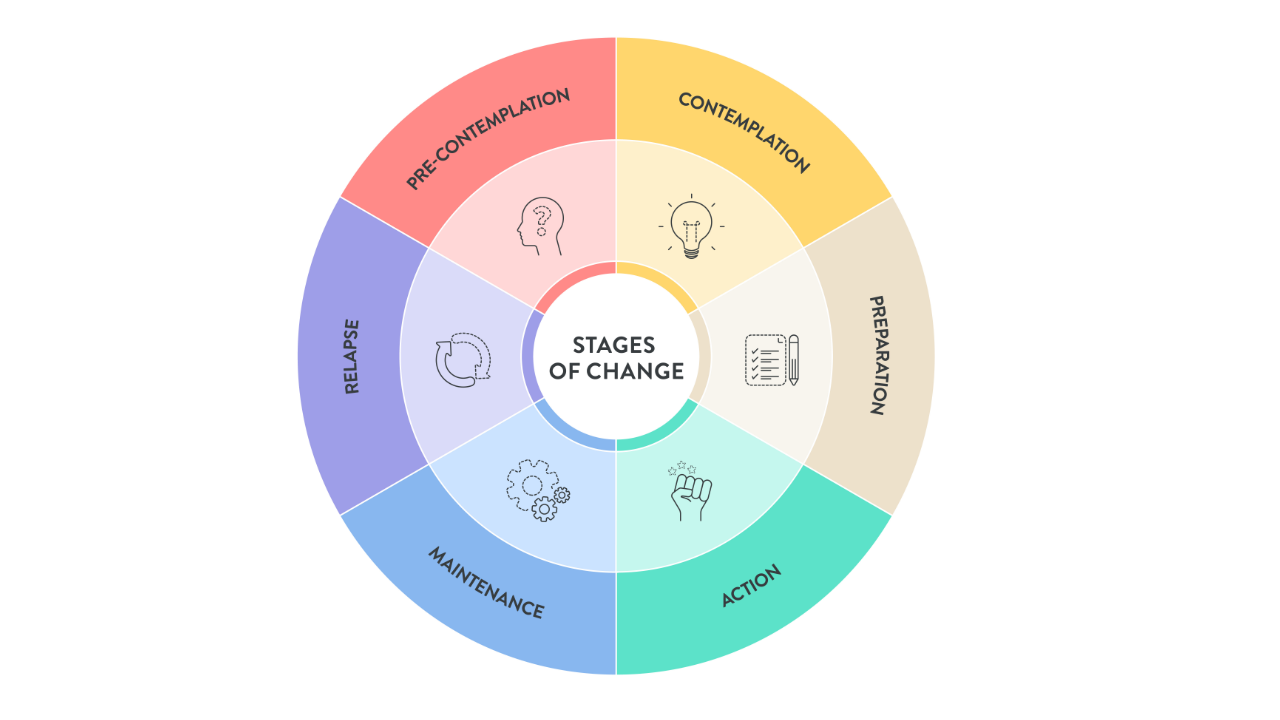
At Mentor Agility, we train coaches to recognize something that is often misunderstood in traditional, goal-driven environments: readiness for change is not a bold declaration or a single decision point. It is a developmental process that unfolds over time, shaped by experience, and capacity, and each person moves through it at their own pace.
Clients frequently arrive to an individual or group coaching session saying they are ready to make change. They are ready to lose weight, repair a relationship, reduce alcohol use, get fit, launch a business, or finally prioritize their health. The desire and frustration they feel is real, yet experienced trauma-informed coaches understand that desire and readiness are not synonymous. In addition to depending on intrinsic motivation, sustainable change depends on capacity, internal safety, and available support.
One of the most enduring frameworks that helps us understand this process is the Transtheoretical Model (https://www.ncbi.nlm.nih.gov/books/NBK556005/), developed by James Prochaska, Carlo DiClemente and colleagues. Often referred to as the Stages of Change, the model outlines five phases: precontemplation, contemplation, preparation, action, and maintenance. Importantly, it also acknowledges that movement is rarely linear. People cycle forward and back, and relapse is not failure. It is information.
In our training, we teach coaches not to reduce clients to stages, but to listen carefully for where they may be situated within the process of change. What is often labeled as precontemplation can sound like minimization or dismissal, yet it frequently reflects protection, a nervous system conserving energy or guarding against perceived threat. Contemplation, while characterized by ambivalence, is not indecision in the negative sense; it is the mind and body weighing risk, safety, identity, and consequence. Preparation tends to be quieter and less externally visible than action, marked not by dramatic shifts, but by the internal gathering of resources, confidence, and support. Action itself may be the most observable stage, yet without sufficient readiness it can be fueled by urgency rather than sustainability. Maintenance, finally, is not merely the repetition of new behaviors, but the gradual integration of those behaviors into one’s sense of self, where change no longer feels performative, but becomes embodied.
For trauma-informed coaches, this framework becomes a map of compassion. When someone has experienced trauma, adversity or chronic stress, readiness is intertwined with regulation. A client may cognitively understand what needs to change, yet their body may still interpret that change as threat.
Consider a veteran who enters coaching with the goal of improving sleep and reducing alcohol use. On the surface, the veteran appears motivated. He has read about sleep hygiene and expresses frustration with their current routine. But as sessions unfold, it becomes clear that late nights feel safer than sleep, and alcohol temporarily quiets hypervigilance. From a purely behavioral lens, he might be categorized in preparation or action. From a trauma-informed lens, he may still be in contemplation, negotiating safety internally.
A coach trained through Mentor Agility does not immediately focus on removing the coping strategy. Instead, the work begins with strengthening capacity. For example, consistent daytime practices are discussed, and predictable evening rituals are built gradually. Self-care becomes stabilization, not reward. As the nervous system experiences more safety, readiness naturally increases. When the veteran begins reducing alcohol, the change feels self-directed rather than forced. What might have looked like slow progress is, in fact, sustainable readiness forming.
Now consider a different example. A mid-career professional approaches coaching determined to leave a high-paying job that has become emotionally draining. She has already drafted a resignation letter and tells her coach she is ready for action. Yet beneath her urgency lies exhaustion, financial uncertainty, and fear of disappointing her colleagues and family. While she frames herself as being in action, she may be in contemplation mixed with adrenaline.
Rather than accelerating her exit, a trauma-informed coach explores foundation first. What would strengthen her sense of stability? What financial clarity is needed? What boundaries can be practiced now, before leaving? What self-care routines would increase resilience? Over several weeks, she builds savings, strengthens sleep habits, improves her health and rehearses boundary conversations. By the time she submits her resignation, she is no longer reacting. She is aligned with her desires and her action emerges from readiness rather than escape.
These examples illustrate why self-care is not secondary in trauma-informed coaching. It is preparatory.
Sleep, nourishment, social connection, reflection, and boundaries expand a client’s window of tolerance. They create physiological steadiness so that change does not automatically activate threat responses. In our programs, we emphasize that building capacity often precedes behavioral change. Coaches learn to assess readiness with curiosity rather than urgency, using reflective listening and scaling questions that preserve autonomy. Our role as trauma-informed coaches is not to rush the stages, but to illuminate them, normalize them, and respect them.
For the coaches we train and support, we encourage you to listen for readiness beneath the goal, and invite your clients to strengthen the foundation before demanding change. When safety and self-care are prioritized, forward motion becomes possible and lasting.
Change is not a performance. It is a human process, and readiness, when honored, becomes one of the most powerful catalysts for lasting transformation.